LBI Construction: A Guide to the Permits You Will Need
You can have the best design and a first-rate builder for your Long Beach Island project, but that is only part of the equation. Before any work is put in the ground, property owners need to be well-versed in the zoning rules and permits that are in place for development on the island. Given LBI’s status as a coastal environment with its own set of environmental sensitivities, you will find that local building codes and state requirements are what allow a project to proceed without a hitch.
It doesn’t matter whether you are building a new home, doing a renovation, raising a foundation, adding a deck, or even doing a flood-resilient rebuild; you must have the right permits in hand. The island is closely regulated for good reason – to safeguard community character, dune systems, property values and safety in the flood zones. Ignore the rules, and you risk stop-work orders, fines, delays and having to pay for a redesign.
Before starting any construction project in LBI, homeowners should understand the local zoning ordinance, the applicable zoning district, and how those rules affect new construction or any construction or building work. In places like Harvey Cedars and Beach Haven, the construction department typically oversees the permitting process, which may involve building permits, a general permit, and final approval for certificates of occupancy. Factors like flood risk, the need to elevate an oceanfront property, or restrictions inside a historic district can all change what is allowed, especially for a single-family home. Because local rules must also align with state law, it’s smart to work with an architect early so you can plan around the requirements before submitting your permit application.
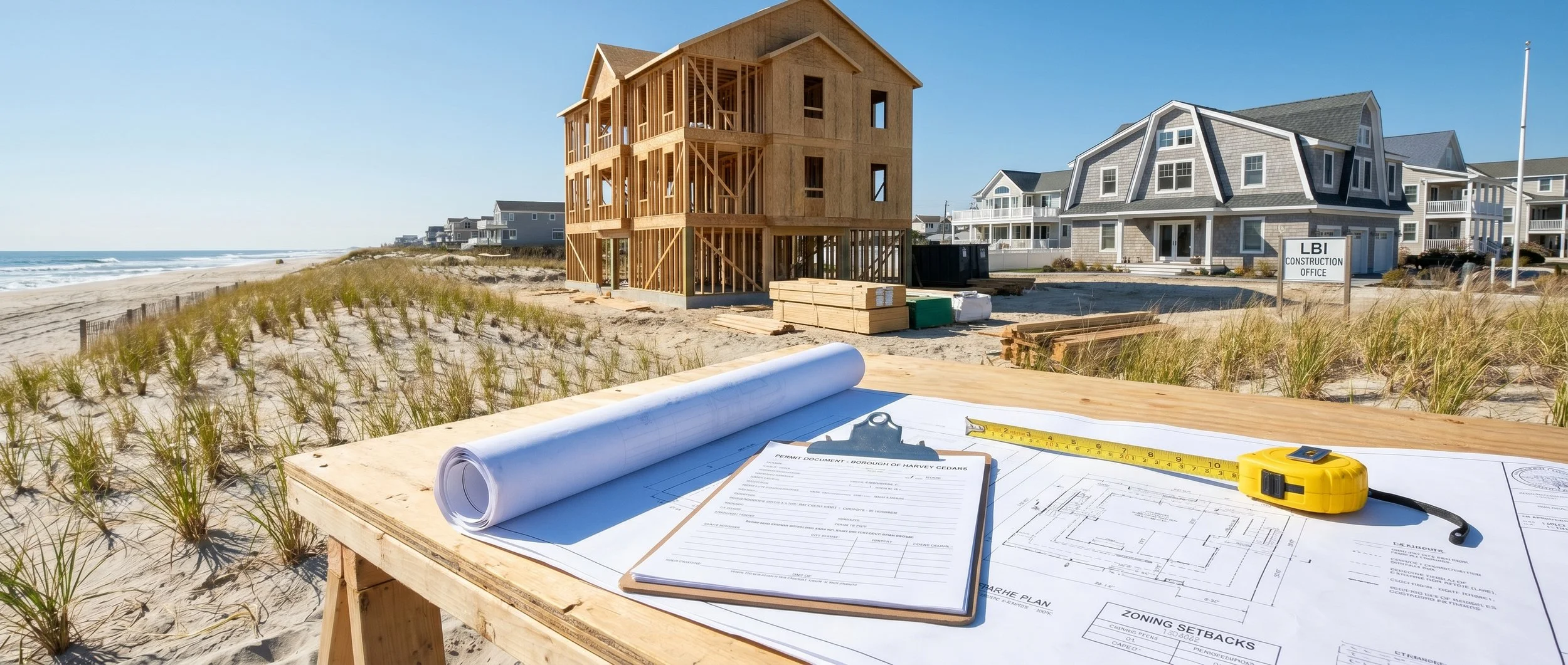
The Importance of Permits on Long Beach Island
Think of a permit as an official stamp of approval from the county, state and local authorities. On LBI, they are all the more critical because of the area’s vulnerability to storm surge, wind loads, coastal flooding and other environmental variables. Towns like Beach Haven, Surf City, Ship Bottom, Harvey Cedars, and Long Beach Township have their own building and zoning departments to ensure standards are met.
Having a permit in order will:
See that you comply with the New Jersey Uniform Construction Code
Make sure the project is in line with zoning for height, setbacks and lot coverage
Verify the structure is up to snuff for wind and flood zone demands
Keep you out of trouble with insurers or the law down the road
Ensure development on the island remains orderly
Even a modest undertaking may call for one or more of these.
What Kind of Work Requires a Permit?
There is a misconception among some homeowners that only a new build needs to be approved. In LBI, most projects do. You could be looking at permit requirements for anything from an addition or a raised foundation to updating your electrical, plumbing, or HVAC, replacing siding, or making structural repairs.
Typically you will need to secure a permit for:
Constructing a new home
Any additions or second-story work
Decks, porches, and balconies
Putting on a new roof
Replacing windows or doors where there are structural implications
Interior work on load-bearing walls
Lifting the house or any foundation work
Upgrades to mechanical and utility systems
Demolition, reconstruction or bulkhead projects
When in doubt, it is a good idea to put in a call to the local construction official or zoning office to see what is called for.
Zoning Rules to Be Aware Of
Zoning dictates what you can build and how you use your land. Here on LBI, those regulations are often about managing flood and environmental risk while keeping the density and neighborhood feel in check. Since the rules can be quite different from one municipality to the next, don’t assume what was fine in one town will be in another.
You will be looking at factors such as:
How far back you must set from property lines
Limits on building height and footprint
Lot coverage and floor area ratios
Parking and allowed uses (single versus multi-family)
Any restrictions on dunes or work in a flood hazard area
Compliance can be a design challenge on many LBI properties, particularly the narrow or nonconforming ones. A lot might be “pre-existing nonconforming” and legally allowed to stand as is, but if you want to expand or put something new in its place, expect a thorough review and perhaps the need for a variance.
Dealing with Flood Zone Regulations
Then there is the matter of the flood zones. This is a major consideration in any LBI construction plan. With much of the island in FEMA-designated areas, your structures have to be designed to meet elevation standards and keep flood damage to a minimum. You will often find that projects in Special Flood Hazard Areas have to adhere to a certain set of standards. These can include:
Raising the lowest floor to be above the base flood elevation
Putting in flood vents as called for
Properly anchoring the structure
Shielding utility systems from any flood damage
Opting for materials that are resistant to flooding below the design elevation
Then there are the local ordinances and New Jersey building code requirements to contend with, on top of FEMA’s rules. Should a structure be deemed substantially improved or damaged, you may be put to the task of bringing it into full compliance with today’s flood regulations, which has a way of impacting both the design and the bottom line.
The Local Building Department’s Part to Play
For the most part, the local building department is the agency you will deal with when it comes to permit applications and construction inspections. They are the ones who will go over your plans to make sure they hold up to building codes, fire safety and energy standards, structural demands and, of course, flood regulations.
The actual process for a permit will vary from one municipality to another but could encompass:
A review of your zoning and construction code
Engineering and fire subcode reviews
Approvals for utilities or site plans
Floodplain development and plan submissions
And once you have your permits, expect to have inspections at key points in the project – foundation, framing, the electrical and plumbing work, insulation, and so on until completion. You can’t legally move forward without them.
Do I Need a Zoning Variance in LBI?
If you want an exception to the rule because your project doesn’t quite fit the existing zoning, then yes. This is not uncommon in LBI, where you have your share of small, irregular, or nonconforming lots. You might run into a need for a variance if you are dealing with:
Setbacks that don’t measure up
A lot that is too small for what you want to build
Height restrictions or too much coverage on the lot
An expansion of something already nonconforming
Any change that puts you over the allowed floor area
These are typically put before a planning or local zoning board. It is a process that takes time and can mean public hearings and putting together professional drawings. There is no guarantee you will get a variance, but to make some projects workable, you have to have one.
Steer Clear of Permit Delays
Coastal work tends to be more involved than an inland build, and a misstep in the permitting phase can be a major setback. The way to avoid that is to do your planning up front and put yourself in the hands of professionals who know the LBI system.
We recommend you:
Have a word with the local zoning office before you lock in your plans
See if the property is conforming or not
Look over the FEMA maps and what they require for elevation
Make sure you have all your ducks in a row with septic, drainage, and utility needs
Put in a complete application
Nothing slows down approval like an incomplete file. If you are short on an elevation certificate, contractor info, or the engineering details, you will be waiting.
The Value of Local Know-How
Getting a permit in LBI is a different animal than in a typical town on the mainland. Every municipality has its own ordinance, and the coastal environment adds another layer of regulation. A builder who has been around on Long Beach Island will have a better feel for how to work within the rules and head off problems before they arise.
That kind of experience goes a long way in:
Making sense of municipal zoning
Dealing with the building department and zoning boards
Getting the flood and coastal code right
Working through a variance
It is expertise that can put money back in your pocket and save you time.
A Few Things to Keep in Mind
Don’t think of zoning and permits as mere paperwork; they are what make an LBI project a success, whether you are doing a renovation or a flood rebuild. In a place where resilience is paramount, you have to comply. But with the right team and some forethought on the local procedures, you can see your project through in a sound way, by the book and in keeping with the community.