
What to Know Before You Build in Surf City: A Home Builder’s Perspective on LBI
There is a certain reward to be had from building a home in Surf City on Long Beach Island, but it is an endeavor that calls for technical know-how, some patience with the regulations and a good head for coastal realities. It is not like putting up a house inland; on a barrier island you have to strike a balance between what you want architecturally and what the environment will allow. Whether it is wind resistance, the soil underfoot or local zoning, your choices have more weight here. If you are going to engage a home builder in Surf City, you need to come to the table with an understanding of coastal construction. It is the foundation of the whole project.
The LBI Difference
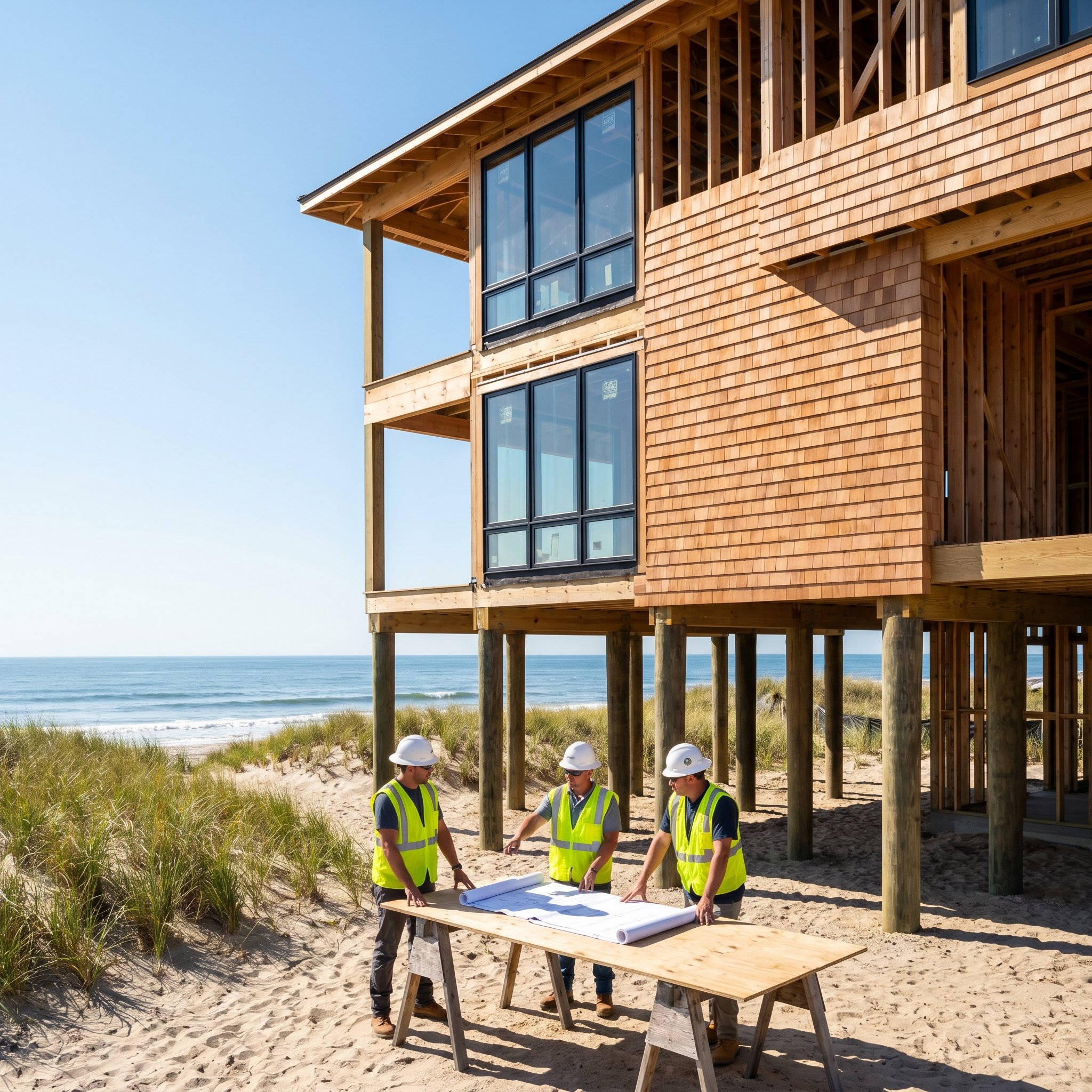
Long Beach Island is a narrow piece of land at the mercy of the Atlantic – the tides, the salt air, the weather systems and the ground itself. All of this has a bearing on how you prepare a site and pick your materials. An inland house might not make it on LBI if it isn’t built for the rigors of the coast. That is where a builder with actual experience in Surf City comes in. They don’t just know residential construction in the abstract; they are versed in the particularities of barrier-island development where you can’t separate resilience from code compliance.
Take elevation for instance. This is the first thing that matters. LBI has its own set of floodplain standards that are hard to ignore. To put the living area above the Base Flood Elevation (BFE) you may need to build up on pilings or put in an engineered footing capable of handling storm surge. A builder who doesn’t have these requirements down pat will see his work derailed by permitting headaches or expensive re-dos, not to mention the structural risks down the line.
Dealing with FEMA and Flood Zones
Before breaking ground on LBI you should be familiar with the local flood ordinances and what FEMA has to say about them. Surf City has to follow federal floodplain management rules, as do the other towns on the island, to keep insurance viable and the public safe.
Your home’s elevation will dictate the cost and the look of the place. Going higher might mean you have to factor in an elevator or longer runs of stairs, all while trying to keep the design appealing. And the flood zone you are in will tell you if you need breakaway walls on the lower level or if certain mechanicals have to be put in above grade.
A good home builder in Surf City will be in touch with the surveyors, engineers and officials to get the elevations right before he starts. Don’t think of it as red tape; it is one of the most important things you will do in the early going.
The Ground Beneath You
Then there is the matter of the soil. Inland you have dense earth; here on the barrier island it is sandy and has a way of shifting. Sand does not bear load the same way and is prone to erosion, so your foundation has to be designed for it.
You will find builders on LBI using deep foundations or pilings to get the structural loads into something more stable. It is not routine work. A competent builder will treat the foundation as the most technically demanding part of the job because getting it wrong invites water intrusion and instability that you would rather not have to pay to fix later on.
Withstanding the Wind
And of course, you have to plan for the wind. LBI gets hit hard by nor’easters and hurricanes, so the home has to be able to take lateral forces. This is true for everything from the framing and roof to the cladding and windows. You may be looking at impact-rated glass and reinforced connections on the roof simply to meet the code and have a structure that will hold up. There is a case to be made for the geometry of the roof. In high-wind conditions, you will find that a simpler roofline is usually more effective since it offers less surface area for the elements to get at. And while overhangs and other architectural flourishes can add character, they have to be engineered with care so as not to introduce any weak points.
If you are working with a builder who has LBI under his belt, he will know how to put together a home that is both refined and in keeping with code. You don’t need your coastal construction to be purely utilitarian, but there has to be some discipline to it.
Moisture Management and Material Selection
In Surf City, moisture is the name of the game. Between the salt air, the humidity and wind-driven rain, managing it is paramount. You may see something appealing in a showroom, but unless you are selective, those materials won’t last long in a marine environment. Everything from wood siding and exterior trim to roofing components and fasteners must be chosen for their ability to resist corrosion.
A good builder will be on top of this. They will point you toward hot-dipped galvanized or stainless steel fasteners, composite decking and marine-grade hardware. Even your plumbing fixtures and HVAC may require some shielding from the salt.
The same applies inside. To keep mold and excess humidity at bay, you need sound drainage, ventilation and insulation, as well as proper vapor barriers. A competent builder in Surf City doesn’t view moisture as an isolated problem; he sees it as an environmental constant that dictates the whole structure.
Permitting, Zoning and Local Coordination
Then there is the matter of dealing with the municipality. Surf City has its rules when it comes to zoning, lot coverage, height and setbacks. In such a regulated part of the coast, even the most beautiful design can be reined in by them.
Preconstruction planning is where you avoid trouble. A seasoned builder will have already been through the local ordinances and talked with the municipal reviewers and your architect before you break ground. If the plans are not in order, you can expect permitting delays. It might seem like red tape to a homeowner, but it is strategic work. The more you iron out at the beginning, the smoother things go down the line.
Designing for the Environment and Your Lifestyle
But building on LBI isn’t just about withstanding the weather. It is also about making a place to live. Whether the home is a rental, a spot for the whole family to get together, or a seasonal escape, the floor plan should make sense for beach living. We are talking about durable surfaces, plenty of storage, an outdoor shower and easy flow from the house to the yard.
With an elevated home, you might use the ground level for parking and equipment and save the upper floors for open entertaining and water views. A builder worth his salt will make sure the technical side of the home accommodates these lifestyle wants.
Picking a Builder in Surf City
You want someone with more than just good hands. Look for a track record in coastal construction and an understanding of the regulations and flood zones here on LBI. Ask him what he has done in the past and how he handles risk and timelines.
In the end, building on LBI is an investment. Do it right and you have a home that is elegant and resilient to its setting. Do it wrong and you are looking at costly fixes and headaches. For anyone putting up a custom home in Surf City, the answer is obvious: you need a builder who can respect the island’s constraints and make something of lasting value out of them. On this island, that kind of expertise is no luxury, it is what the build is built on.
Contact us:
Email: jonathan@fathersonbuild.com
Call: (609) 489-4996
✤ ✤ ✤
Visit Our Showroom:
455 N Main St. Barnegat, NJ 08005