
The Lowdown on CAFRA Permits in the NJ Shore
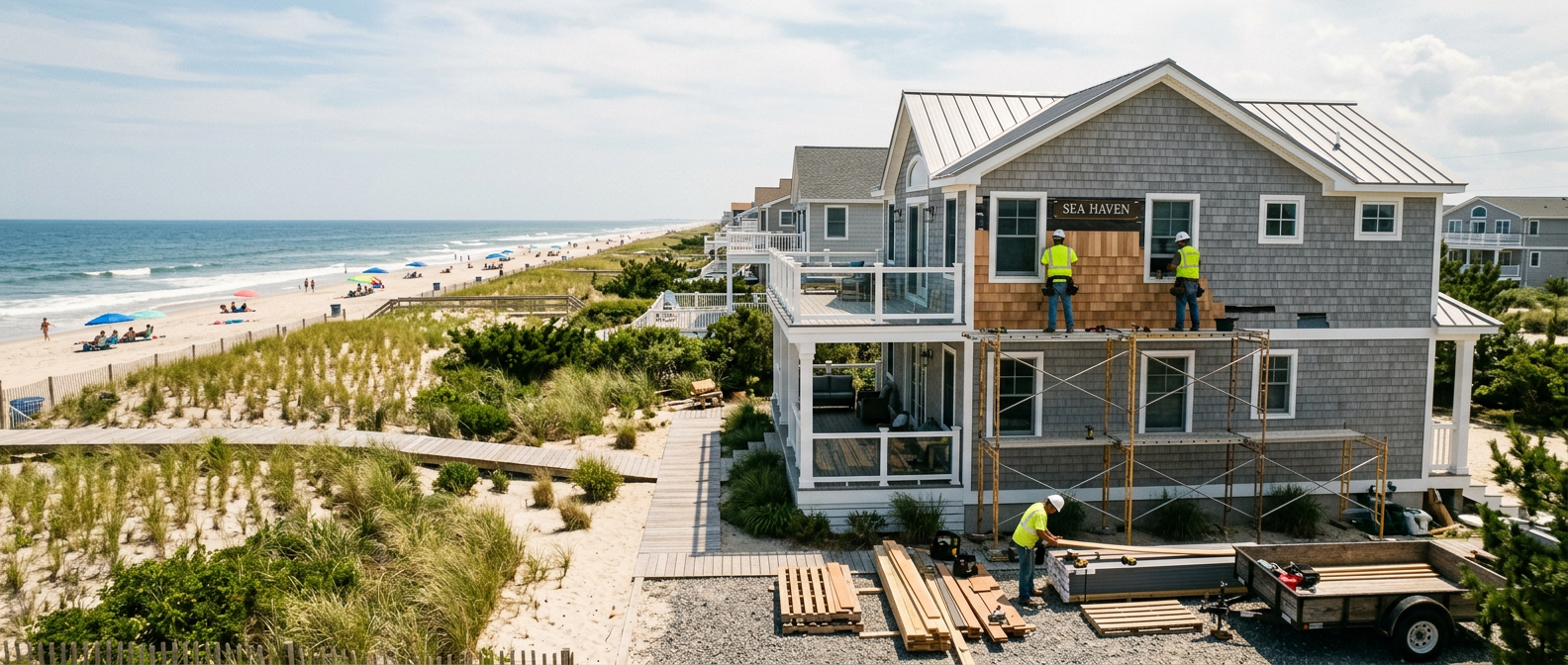
A CAFRA permit is a New Jersey Department of Environmental Protection (NJDEP) approval that may be required before building, renovating, or altering property in regulated coastal areas, including work near beaches, dunes, tidal waters, or the mean high water line. On LBI, projects such as new homes, additions, duplexes, decks, bulkheads, and other shoreline improvements may require a permit, although some work may qualify for an exemption, permit-by-rule, or general permit depending on the site and scope. Because CAFRA requirements are separate from local building approvals, property owners should confirm the applicable permit pathway with NJDEP before beginning construction.
If you’re a property owner, builder, or developer with plans for the New Jersey shore, you’ve likely come across the term “CAFRA permit.” Put simply, it’s a state-level sign-off you can’t do without for a lot of coastal work. Governed by the Coastal Area Facility Review Act and put in place by the New Jersey Department of Environmental Protection (NJDEP), this permit is for anyone looking to put up a structure, make some changes to shoreline property, or do other work in close proximity to the beach, dunes, a bulkhead, or the mean high water line.
You have to be on top of it because the rules in New Jersey are no-nonsense. Go against them and you’re looking at fines, having to re-draw your plans, or a flat-out denial. Whether you are putting in a new home, a duplex, or an addition, getting to grips with what CAFRA requires is the first thing to do if you want to stay in good standing with the state.
In a Nutshell: What Is The CAFRA Permit?
The acronym stands for the Coastal Area Facility Review Act. It’s a piece of New Jersey legislation designed to put some reins on development in more delicate parts of the shore.
The idea is to let you improve your property and build responsibly, but not at the expense of the environment. So when the NJDEP hands out a CAFRA permit, they are doing their due diligence to see if your project is in line with the law and the land. In plain English, it’s how the state makes sure you aren’t building in a way that is unsafe or illegal.
CAFRA, or the Coastal Area Facility Review Act, is a key part of New Jersey’s coastal zone management framework and may require a CAFRA permit for many types of proposed development. Depending on the site and scope of work, residential development, commercial development, industrial development, and public development may all need a construction permit or a CAFRA individual permit if the project could affect coastal resources, coastal wetlands, or a waterway. In some cases, existing development may be exempt from CAFRA, but that depends on the exact location, the applicable CAFRA zone, and whether the work is covered by a general permit under CAFRA regulations and N.J.A.C. requirements.
Because residential or commercial development near the shore can have an environmental impact, property owners often need to confirm whether they require a CAFRA permit before starting work. A detailed individual permit application may be necessary for projects that fall outside of a general permit, while other projects may simply need an inspection or confirmation that they require a permit under current CAFRA amendments. Since each project is different, it is important to evaluate the scope of work, the affected waterfront development area, and the local coastal conditions before moving forward.
Why You Can’t Afford to Overlook The CAFRA Permit Application
The Jersey Shore is one of the most regulated coastlines around. A lot of the land here is in a flood zone or right up against the ocean and features you’re not supposed to tinker with. Even a minor alteration can have a ripple effect on drainage, public access, or the dune system.
For an owner, CAFRA is what tells you if you can even go ahead with something. For a builder or developer, it dictates the timeline, the cost, and how you have to put it together.
Take a deck or a home addition for instance. Your town might give you the green light under local zoning, but the state may still have a say. And if you don’t get that state review, you can run into some serious roadblocks.
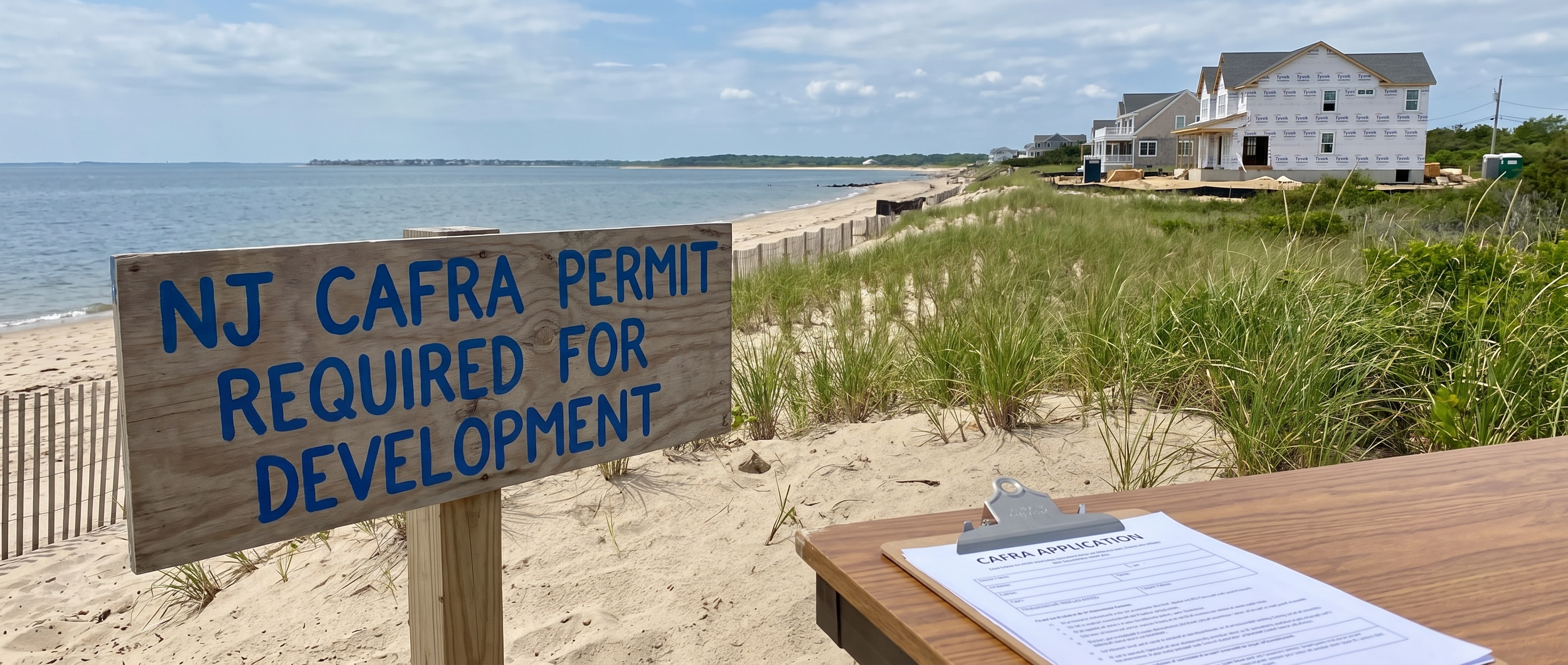
Who Should Be Worrying About This? (Coastal Area Facility Review Act)
You don’t need a CAFRA permit for everything, but for many projects at the shore, you will. If you are in a regulated area and want to do anything that impacts the land or the resources there, you should be in the know.
We see it all the time with:
Homeowners who want to spruce up a place near the water
Builders on a new single-family or duplex
Developers with a fresh project in mind
Contractors in for a reno or an add-on
Folks putting a house back together after a storm
Anyone working in the vicinity of a tidal area or a dune
It doesn’t matter if the local office has given you the OK; if it’s near the mean high water line, the NJDEP may still want to have a look.
When Do You Need to Apply?
There is a wide range of work that can set off a CAFRA review. It comes down to where you are and what you are trying to do.
Here is what typically puts a project in front of the state:
Putting up a new home on the shoreline
Any large addition that means more square footage
A reno that is more than cosmetic
Work in or around a dune or the beach
Fixing or putting in a new bulkhead
Docks, piers, and the like
Moving earth, filling in, or excavating in a sensitive spot
Anything in a flood zone with its own set of restrictions
Sometimes it’s as simple as changing the height of a building or how stormwater is channeled. It’s not just about the ‘what’ of your build, but the ‘where’.
Are There Any Loopholes?
There are a few cases where you might be able to sidestep the full CAFRA process, but it really depends on the site and the nature of the work. Here are some of the more common permit exceptions you might come across:
Minor repairs that don’t add to the structure
Some small maintenance jobs that leave coastal conditions as they are
Renovations confined to the interior
Replacing what’s there with something in the same spot
Work that is kept out of any regulated coastal zone
Don’t be fooled into thinking an exception is a given. A lot of folks put in for a project under the assumption it’s exempt, only to find out it isn’t.
If your work is close to the mean high water line, in a flood zone, or has any tie-in to a protected dune or beach, even a modest project can call for a coastal permit. It never hurts to check in with the NJDEP or a pro before you break ground.
The Way the Permit Process Goes
For CAFRA individual permits in New Jersey, applicants must send notice to the municipal clerk, the planning board, the environmental commission, and all property owners within 200 feet of the site boundary.
CAFRA projects listed in the notice rule — including linear projects of one-half mile or longer and shore protection developments of one-half mile or longer — require broader public notice under NJDEP rules.
For the most part, a CAFRA permit begins with a look at the site. We’ll have to see where the property sits in relation to state and local rules.
In a nutshell, here is what to expect:
Pinpoint the location
First we determine if the property is in a coastal or otherwise regulated area.
What kind of work is it?
The NJDEP will want to know if this is a new build, a home addition, a duplex, or some other form of coastal development.
Look at the environment
We review the proposal to make sure it won’t have an impact on the dunes, wetlands, shoreline, or drainage.
Put together the application
You may be asked for surveys, plans, elevations and the like.
Turn it in to the state
The NJDEP will go over the file for any CAFRA or environmental compliance.
Handle any questions
They might come back for some changes or to ask for more details.
Get the word
Once you have the green light, you can proceed as long as you stick to the terms.
Some of this can be time-consuming, particularly with a complicated job or a sensitive location.
Why You Can’t Underestimate Local Expertise
CAFRA is a statewide rule, but on the ground it doesn’t always play out the same from one piece of property to the next.
Every site has its own story. What you can do may hinge on:
How far you are from the mean high water
Whether you’re up against a dune or bulkhead
Your flood zone
The size of the lot and what has been built on it before
Town zoning
A contractor or permit specialist who knows the area can tell you how the state’s rules are actually enforced. They can help you put forward a better application and head off any hiccups. For waterfront work, where a tweak in the design can make or break approval, that kind of insight is hard to put a price on.
Some Questions We Get
Is a small project a free pass?
Not necessarily. You might be in the clear, but where you are doing the work is just as important as the scope of it.
If I have a building permit, am I good to go?
No. A local permit and a CAFRA review are two different things. You could be looking at having to get both.
Do all homes on the shore have to comply?
Many do, but not every one. It comes down to the property and what you are planning to do.
I have a damaged home – can I put it back up without a permit?
There are some allowances for that, but it is a case-by-case thing based on the damage and where the home is.
My work is right by a dune or bulkhead.
You can expect a closer look. Those are features the state is keen on protecting.
How much time should I set aside for this?
It depends. A straightforward job will be quicker; a bigger development will take longer to wade through the review.
I’m in a flood zone.
That can put some extra restrictions on you and could be the reason you need a permit in the first place.
In the End
Getting a CAFRA permit for your NJ shore project is about more than just filling out forms. It is how we ensure that development is done by the book, in a way that is compliant and doesn’t harm the coast.
So whether you are putting up a new home, an addition, or a duplex, it pays to know the rules. And if you are in any doubt about what you need, or if you want some guidance on the process, reach out to a professional who has a handle on the regulations in New Jersey.
