Piles, Piers, and Helical Piles: A Look at Coastal Foundations
When building a coastal home in New Jersey, the most common coastal home foundation types include piles, piers, and helical piles — each engineered to elevate the structure above flood levels, resist storm surge, and meet NJ's strict FEMA and local building code requirements. The right foundation depends on your specific soil conditions, flood zone designation, and site location along the NJ coastline.
Style has its part to play in foundation design here, but in Long Beach Island, you are also dealing with the realities of a barrier island – tidal exposure, soil makeup, and elevation mandates. The best coastal home foundation types that NJ builders put in place are chosen with a mix of local know-how and engineering. You will see a lot of piles, piers, and helical piles for good reason; each has its merits depending on the site and the home.
What Makes Beach Houses Foundation Important in LBI
A good coastal foundation has to do more than hold up a house. It has to put the structure out of harm’s way from flooding, stand up to lateral pressure from the elements, and hold firm in wet or sandy ground. With the kind of storms and high water tables you get on the island, how you approach the foundation is one of the first calls you will make when building.
Homeowners weighing their options want to do more than just satisfy the code. They are after a system that is elevated and durable, one that protects the investment while fitting the architecture. Done right, it can open up views and give you usable space under the home, all in keeping with the open feel of a fine beach house.
Pile Foundation: The Workhorse of Coastal Homes
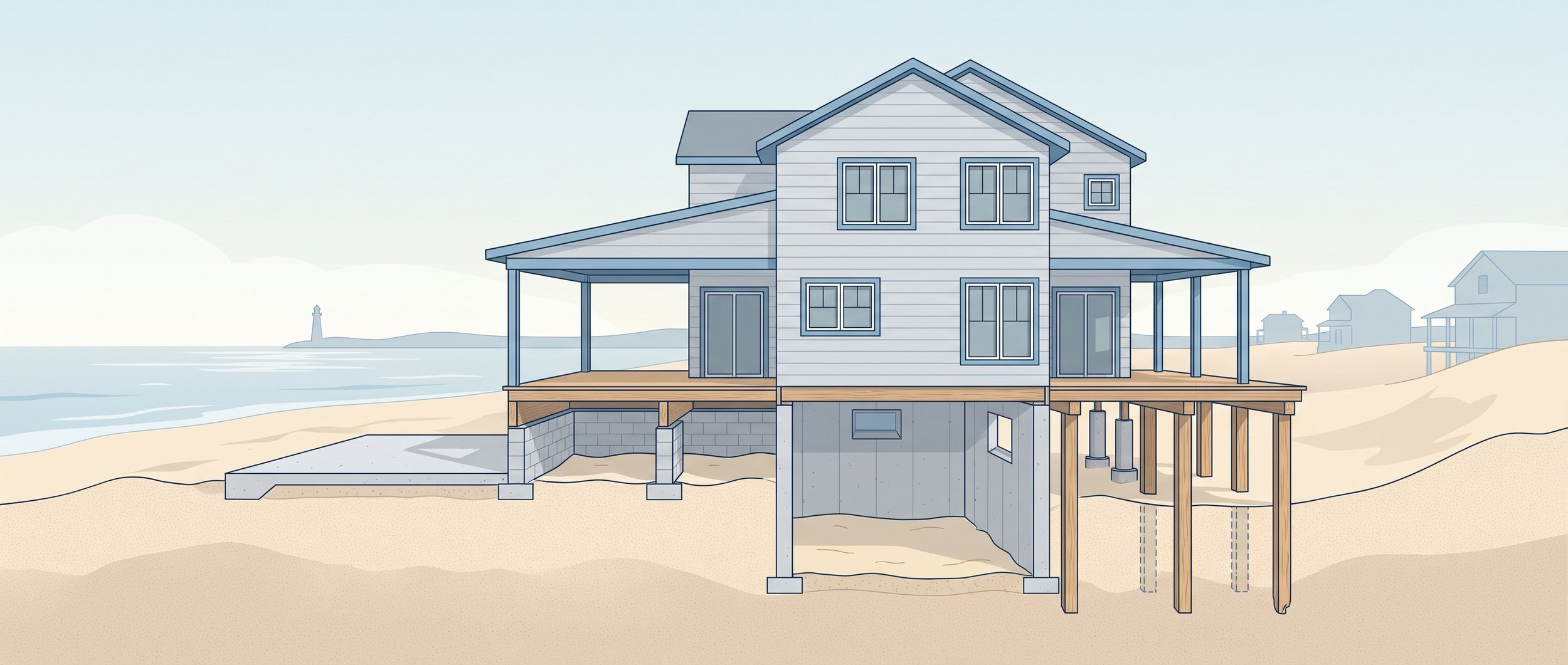
For an elevated home in a beach community, there are few coastal home foundation types NJ contractors trust more than piles. Put simply, they are long structural members driven well into the earth until they hit soil capable of bearing the house’s weight. They do the job of transferring that load down and keeping things from moving.
You will find them made of steel, concrete, or treated timber on LBI, the material dictated by the project. Timber is still very much in vogue for many shore homes because it is practical and tried and true, though you may see concrete or steel in a more heavily engineered or high-end build.
The advantage is clear: they anchor you in unstable ground. Shallow foundations don’t cut it for new construction on the shifting sands of Long Beach Island. Piles get you to the reliable layers below and are necessary to meet base flood elevation requirements. On a custom home or big renovation, a pile foundation can be so well integrated into the plan that you hardly notice it, leaving the home to look light and airy while being solidly put in place.
Piers for Elevation and Flexibility Of Beach House Foundations
Then there are piers. Another of the coastal home foundation types you will come across, a pier system uses vertical supports of masonry, concrete, or some other engineered material to take the load at key points.
In a coastal setting, they are usually part of an elevated setup. The difference with piers is that they are spaced out rather than forming a continuous wall. That is an asset in a flood zone like this, as it lets the water run under the house instead of having to press against it. For a builder working on a remodel, piers offer a certain flexibility, allowing him to work within the footprint and layout of an older property. Where the site demands it, a pier-based approach will offer the support you need while working within its limitations. But piers are not to be taken for granted; they have to be engineered with care. Since you are dealing with point supports and not a continuous system, the sizing, depth, and placement are all vital. A coastal builder of experience will make sure the layout of the piers is in keeping with the home’s load paths as well as the soil and flood conditions on the ground.
Helical Piles: Precision for Sites With Challenging Foundation Requirements
For shore construction and renovation in New Jersey, helical piles are fast becoming one of the most valuable coastal home foundation types to offer. You will find these steel shafts with their helical plates being mechanically screwed into the earth instead of being driven in. It is a precise affair, quicker and less of an intrusion than the old way of doing things.
They come in handy when you have sensitive surroundings or soil that makes conventional pile driving a non-starter. On Long Beach Island, where your lot may be tight, and the neighbors are right next door, that is no small thing. There is also less vibration to worry about, so you do not put undue stress on adjoining structures. Then there is the matter of predictability. The builder can watch the installation and be certain the pile is attaining the required load-bearing capacity, which is appealing for custom work or a renovation that calls for exact performance.
You won’t see helical piles on every project, but they figure prominently in the discussion for those wanting an efficient, engineered solution. They might be what you use for a deck or an addition, or they could form the backbone of a full foundation for a luxury residence.
Choosing the Right Beach Home Foundation for a Long Beach Island Home
When it comes to picking from the coastal home foundation types NJ builders employ, there are variables to consider: the home’s style and size, the elevation you need, the flood zone, the soil, and whether you are building new or renovating. Local knowledge is key on LBI because no two properties are cut from the same cloth.
A custom builder who knows the island will look at what is structurally sound and what is strategically wise. A big custom home might be better off with a deep-pile system for the extra height and load. A renovation with restricted access would be suited to helical piles to keep disturbance to a minimum. Or perhaps a design calling for good airflow and flood resilience is best served by a pier system. In the end, the strategy has to be specific to the site, honoring both the architecture and the code. That is where design-build expertise pays off.
Foundation Design and the Luxury Coastal Experience
The foundation may not be the first thing you notice in a house, but for many, it is integral to the luxury of the place. The strong, well-thought-out system is what allows an elevated home here on Long Beach Island to have its graceful stair access, ground-level storage, and room for shaded outdoor living without sacrificing the view.
Looking at coastal home foundation types in NJ, one should think in terms of more than just engineering. How the house sits on the lot and performs over time is down to the foundation. From the rooms above, a properly built shore home should seem effortless, even if there was a lot of technical work put in below. It is structural intelligence with a touch of refinement.
Aspects Of Coastal Home Foundation Types
Building a beach home on the East Coast requires a deep understanding of the unique challenges that come with coastal construction — from shifting soil conditions and relentless erosion to strict FEMA flood zone regulations and local building codes that govern every aspect of a new home build. Unlike standard residential construction, coastal areas demand a foundation system that can withstand powerful storm surges, floodwater, and extreme wind loading without compromising long-term stability. The two primary construction methods used for beach house foundations are open foundations and closed foundations — each with distinct advantages depending on your site. Pier foundations, which elevate the structure above base flood elevation on concrete and steel pilings, are among the most common open foundations used along the coast, offering the structural resilience needed to handle hydrostatic pressure and wave action. Closed foundations, such as a slab system, may be used in certain lower-risk zones but must meet elevated foundation requirements to remain stable over time. Regardless of the approach, corrosion-resistant materials are essential in the salt air environment, and working with an experienced coastal contractor ensures your solid foundation is engineered to protect your investment for decades to come — so your outdoor living design and everything above it stands strong through every season.
Building with Confidence on Long Beach Island
Whether you have a custom build or a shore renovation in the works, making sense of coastal home foundation types in NJ is a good place to start. Piers, helical piles, and the like each have their merits, and the right one is a function of your property and what you want to achieve.
In a market such as LBI, you want a foundation with some durability and precision behind it to stand up to the salt air and the storms. It is the unseen framework that safeguards your home. For a beach property that is as resilient as it is attractive, that is where you will find the real value.