
A Practical Guide to Reverse Living House Plans in New Jersey Coastal Homes
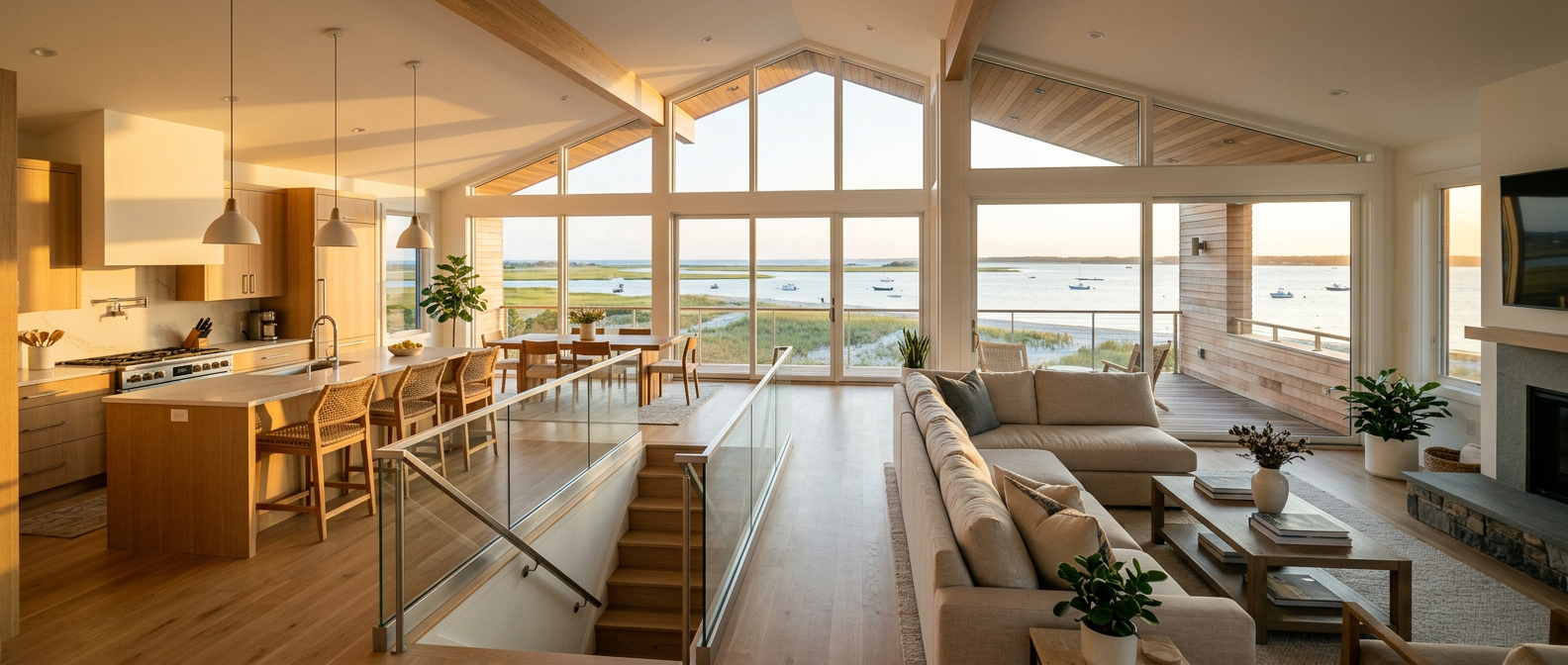
You could call it an upside-down house, but LBI builders are more likely to refer to it as reverse living. It is a design that inverts the conventional home plan: put the kitchen, dining and living rooms on the second floor and relegate the bedrooms and baths to the level below. For coastal New Jersey homes, this is not just a matter of style; it is a way to make vertical living feel both natural and efficient.
A reverse living home is a smart home design approach that places the main living areas on the top floor to take advantage of panoramic views, more sunlight, and a brighter everyday experience. This style of living design often features open plan living, an open plan kitchen, and flexible gathering spaces that feel connected and spacious, with tall ceiling lines that enhance the architectural feel. A skilled architect can make a stunning reverse living layout that balances function, comfort, and style while creating a dramatic coastal look.
In many cases, a reverse living plan also improves access to outdoor decks, making it easy to move between indoor and outdoor spaces for entertaining and relaxing. Whether it is a new build or a future modification to an existing property, this architectural layout can transform a house into a bright, view-focused retreat that makes the most of every square foot.
The Meaning of Reverse Living Floor Plans
In a typical reverse living house plan, you will find your primary living spaces up top. Downstairs is where you’ll do your laundry, store things and sleep. We see this view-oriented layout chosen for a number of good reasons: it affords better water views and sightlines over your neighbors, it puts your main living areas out of harm’s way when it comes to flood risk, and it forges a solid link between the inside of the house and any elevated decks. Put simply, it is a floor plan made for the coast.
Why You See Reverse Living House Plans on LBI
There is a certain pattern to home building on Long Beach Island that makes reverse living particularly well suited to the area. Much of the property here is low-lying, and flood zone regulations have a say in how a home is put together. As a result, our builders on LBI will often work with elevated plans that raise the main floor above grade.
It is a functional answer to the shoreline environment, one that accords with the realities of local zoning and building codes, the demands of storm protection, and the conditions of an oceanfront or bayfront lot.
The Advantages Of A Reverse Living Floor Plan
For a home in coastal New Jersey, there are practical benefits to be had:
The view: From the upper floor you can take in the bay or the ocean even if dunes or other houses would block your line of sight from the ground.
Privacy: Entertaining is done upstairs, away from the street, while the sleeping quarters downstairs are kept separate and private.
Flood strategy: You can never fully eliminate risk, but putting your day-to-day living space higher up is a sound approach to storm protection.
Indoor-outdoor flow: An open-concept living room on the top floor can open right up to a deck, giving the home a sense of space.
Flexibility: Whether you are adding on, doing a reconstruction or starting from scratch, the design is adaptable.
What the Layout Looks Like
If you were to walk through a standard reverse living plan, the lower level would have your entry, garage, mechanicals, guest rooms and full baths. Come up to the upper level and you have the social heart of the home – the living room, kitchen and dining area with large windows and perhaps a rooftop terrace.
The Builder’s Perspective
We recommend it because it addresses a host of shore-house problems in one go. Many of the lots on Long Beach Island are constrained by setbacks or are simply narrow and shallow; a reverse living arrangement lets you get the most out of your space without having to push the footprint too far. And for today’s buyer who wants a roomy, light-filled open concept with a view of the water, it is the right way to build. There is a certain market appeal to a well-executed reverse living plan, and for the right buyer it can be hard to beat. Take the beach house shopper, for instance: a traditional layout has its place, but a reverse design tends to feel more desirable, delivering that premium coastal experience they are after.
Is it right for you?
While reverse living is a no-brainer for some coastal properties, it does not suit every circumstance. Before you commit, here are a few things to give some thought to.
Stairs and accessibility You will be doing more climbing since your day-to-day life is upstairs. That is something older homeowners or families with an eye on long-term access should factor in.
Furnishing and upkeep Getting furniture up to an upper-level space can be a bit of a chore, particularly if you have a narrow stairwell.
HVAC To keep a large open area on the second floor both comfortable and efficient, you need to put some planning into your heating and cooling.
Resale It is all the rage on the coast, but you may have to educate a buyer from inland as to why the layout works.
The rules of the road Do not forget local zoning and building codes. They will have a say in how high you can build, where your stairs go, the size of your deck and the general form of the house.
Converting what you have
Some opt to reconfigure an older shore home to meet modern standards rather than tear it down and start over. If you are looking at a major addition or reconstruction, you might consider moving the kitchen and primary living room up, reroofing the stairs for better flow, or putting in new windows and decks for the view. You could also put the guest rooms and bedrooms on the lower floor. It is not for every property, but with the right structure it is a cost-effective way to go.
A few questions we get asked
So what is a reverse living plan?
Simply put, it puts your main living spaces on the top floor with the bedrooms underfoot.
Why is it so common in coastal New Jersey?
It is about making the most of the ocean view and meeting the needs of elevated homes in areas prone to flooding and storms.
Is this only for new builds?
Not at all. As long as the zoning and structure permit, you can do it with an addition or during a reno.
Good for a family?
If you want a layout that is conducive to beach life and open gathering, then yes.
In the end
For NJ homeowners, going with a reverse living floor plan is rarely just a matter of taste. It is a response to the realities of the coast – the building codes, the flood zones, and the bay or ocean views you want to enjoy. LBI builders will tell you that in an environment where the shoreline dictates much of what you do, it is one of the best ways to put up a beach house that is as durable as it is view-forward.
Whether you are adding on or building from the ground up, it is worth having a conversation with a builder who knows the local zoning and coastal construction. Done right, the layout will make your home feel like it belongs on the Jersey Shore.
